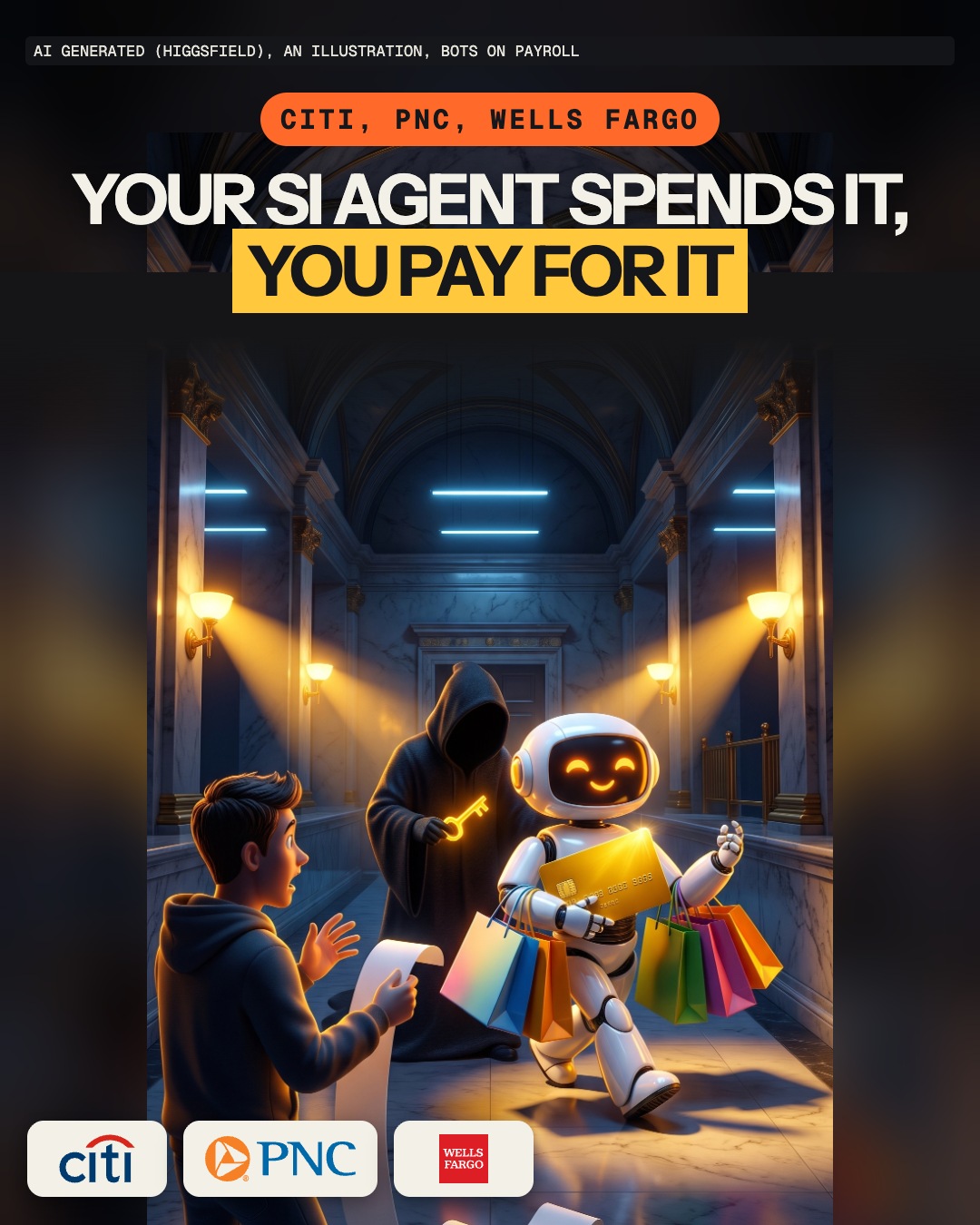
YOUR AI AGENT SPENDS IT, YOU PAY FOR IT
Citi added a new section to its Online User Agreement this month: anything a third-party AI agent does with your login counts as authorized by you, and if the credentials you gave it are shared or leaked, Citi treats what follows as yours too. PNC changed its terms on Nov 18 and bars giving agents your password or one-time codes. Wells Fargo's new Section 15 starts Nov 24 and says using an AI agent is at your own risk. Federal rules (Regulation E) protect you from transfers you didn't authorize, but whether an agent you set up counts hasn't been tested. Read your bank's agreement before you connect any AI shopping agent.
By Bots on Payroll, with 7 sources below

The short version
- Citi added Section H, Use of Third-Party AI Agents, to its Online User Agreement this month.
- If the login you gave the agent is shared, leaked or otherwise distributed, Citi treats everything done with it as authorized by you.
- PNC changed its digital banking terms on Wednesday, Nov 18, according to TechCrunch, Decrypt and Yahoo Finance.
- Wells Fargo's new Section 15 takes effect Nov 24.
- Federal Regulation E protects you from electronic transfers you didn't authorize, and Yahoo Finance notes a bank agreement can't simply waive it.
- Read your own bank's agreement before you link any AI shopping or budgeting agent.
Watch the video
0:56, sound onThe agent's moves are yours
Citi added Section H, Use of Third-Party AI Agents, to its Online User Agreement this month. If you give an outside agent your login, Citi will consider any access and actions it takes as authorized by you. You're also responsible for errors from the agent misreading what you asked. Citi can limit or cut off agent access at any time.
A leaked login is still on you
If the login you gave the agent is shared, leaked or otherwise distributed, Citi treats everything done with it as authorized by you. That is why TechCrunch says customers are on their own even if they get hacked. Citi's own AI tools are exempt, and the clause itself cautions customers against handing their credentials to outside agents at all.
No passwords for agents
PNC changed its digital banking terms on Wednesday, Nov 18, according to TechCrunch, Decrypt and Yahoo Finance. Customers may connect only through methods the bank approves, and may not give an AI agent their password or one time security codes. Agents generally can't start payments unless PNC allows it. We couldn't open PNC's new text itself.
At your own risk
Wells Fargo's new Section 15 takes effect Nov 24. Instructions sent by an AI agent using your login are deemed initiated and authorized by you, without further checks. Its words: your use of any AI agent is at your own risk. If you revoke an agent, you must keep proof and show it when asked. The bank says it isn't responsible for agents.
Still an open question
Federal Regulation E protects you from electronic transfers you didn't authorize, and Yahoo Finance notes a bank agreement can't simply waive it. But the rule excludes transfers by someone you gave your access to, and nobody has tested whether an AI agent counts. A lawyer for America's Credit Unions calls it an open question. JPMorgan and Bank of America moved first, in October.
Before you connect one
Read your own bank's agreement before you link any AI shopping or budgeting agent. Bank of America asked customers on Oct 27 not to share banking passwords with an AI assistant, and PNC now bars it. If you do revoke an agent, keep proof, as Wells Fargo requires. Report any charge you didn't intend right away and keep the records.
Swipe the post
Sources
More AI news

Spent your weekend on sale posts? One photo could have made all of them.
Your pay stub link still opens. Here's how to lock it.