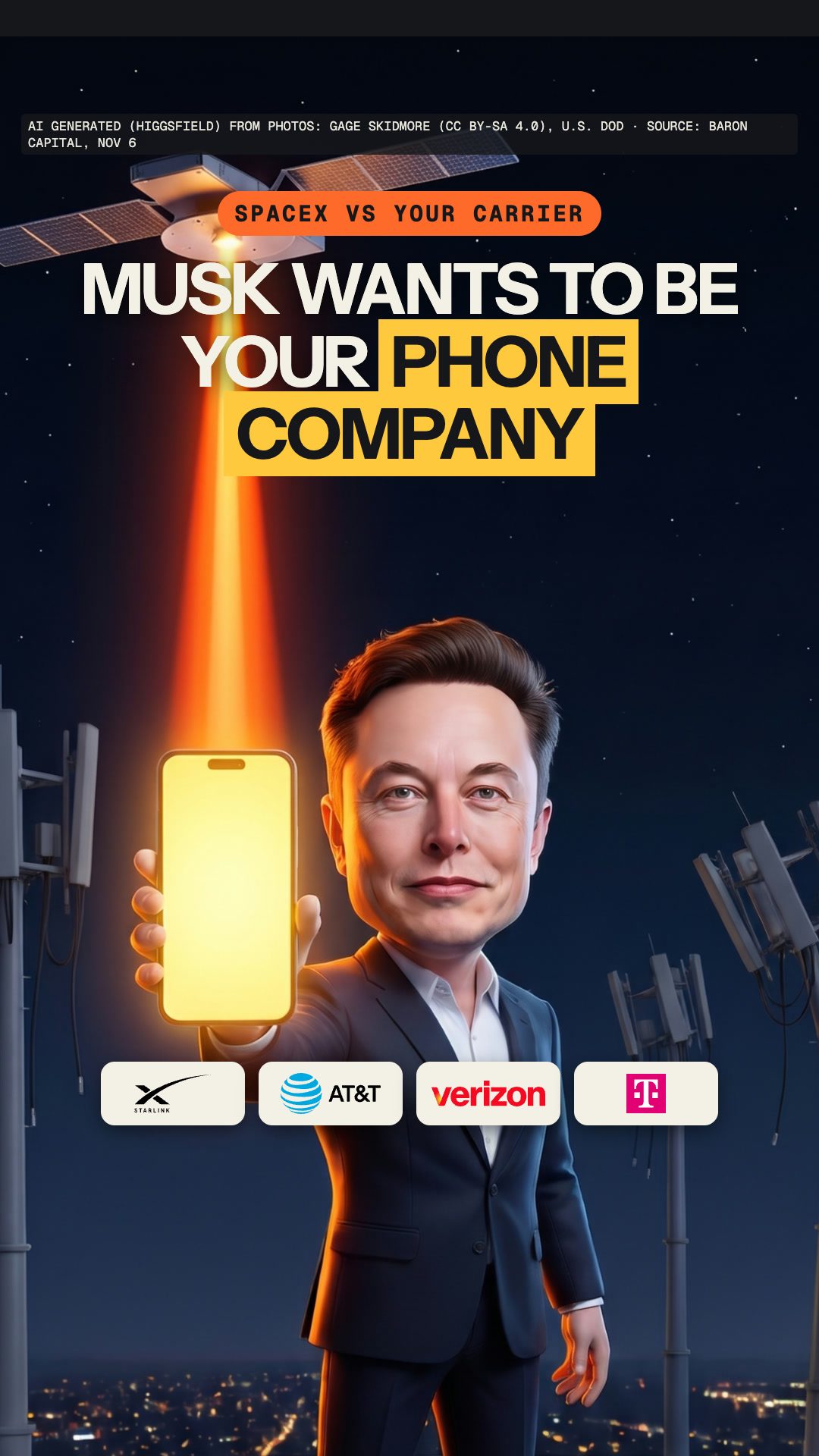
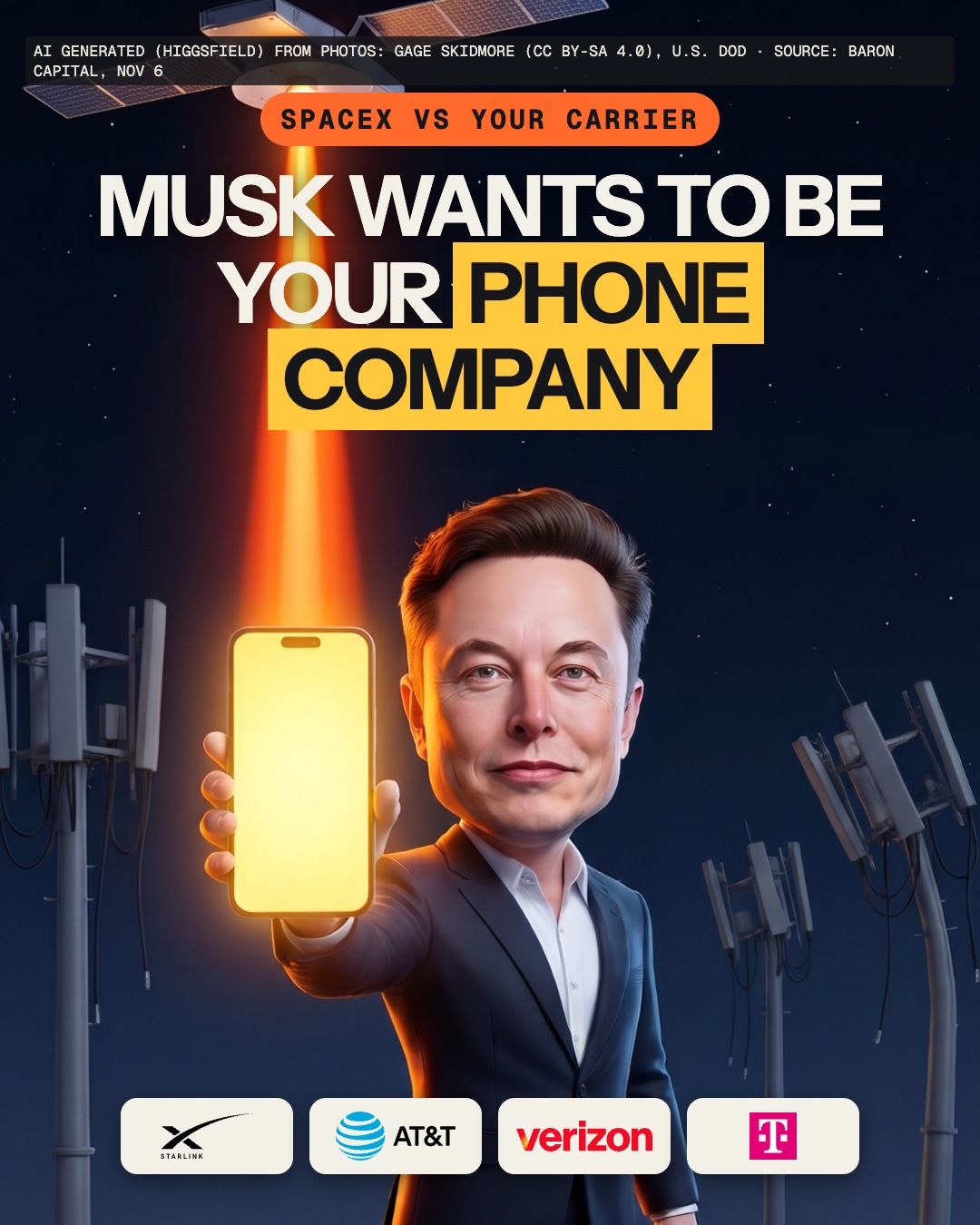
Elon Musk wants to be your phone company
On Nov 6 Musk said SpaceX could buy an old-school carrier and use its airwaves "10 times more effective." It was a what-if: no company named, nothing filed. But SpaceX already owns 65 MHz of airwaves, agreed to buy more in October, and AT&T, Verizon and T-Mobile lost more than $50 billion in one morning when it did. The twist: T-Mobile's satellite texting already runs on Starlink.
By Bots on Payroll, with 16 sources below
The short version
- Musk spoke Nov 6 2026 by video with Ron Baron at the Baron Investment Conference in New York; he named no target and nothing has been filed.
- 24/7 Wall St quotes Musk saying SpaceX could buy a legacy carrier and use its airwaves 'ten times more effectively'; the headline says '10 times better'.
- On Nov 6 T-Mobile rose 0.88% while Verizon and AT&T each fell about 0.9%; Verizon closed at $45.71 and AT&T at $21.63; T-Mobile is down 18.46% year to date.
Watch the video
0:57, sound onSpaceX vs the Big Three
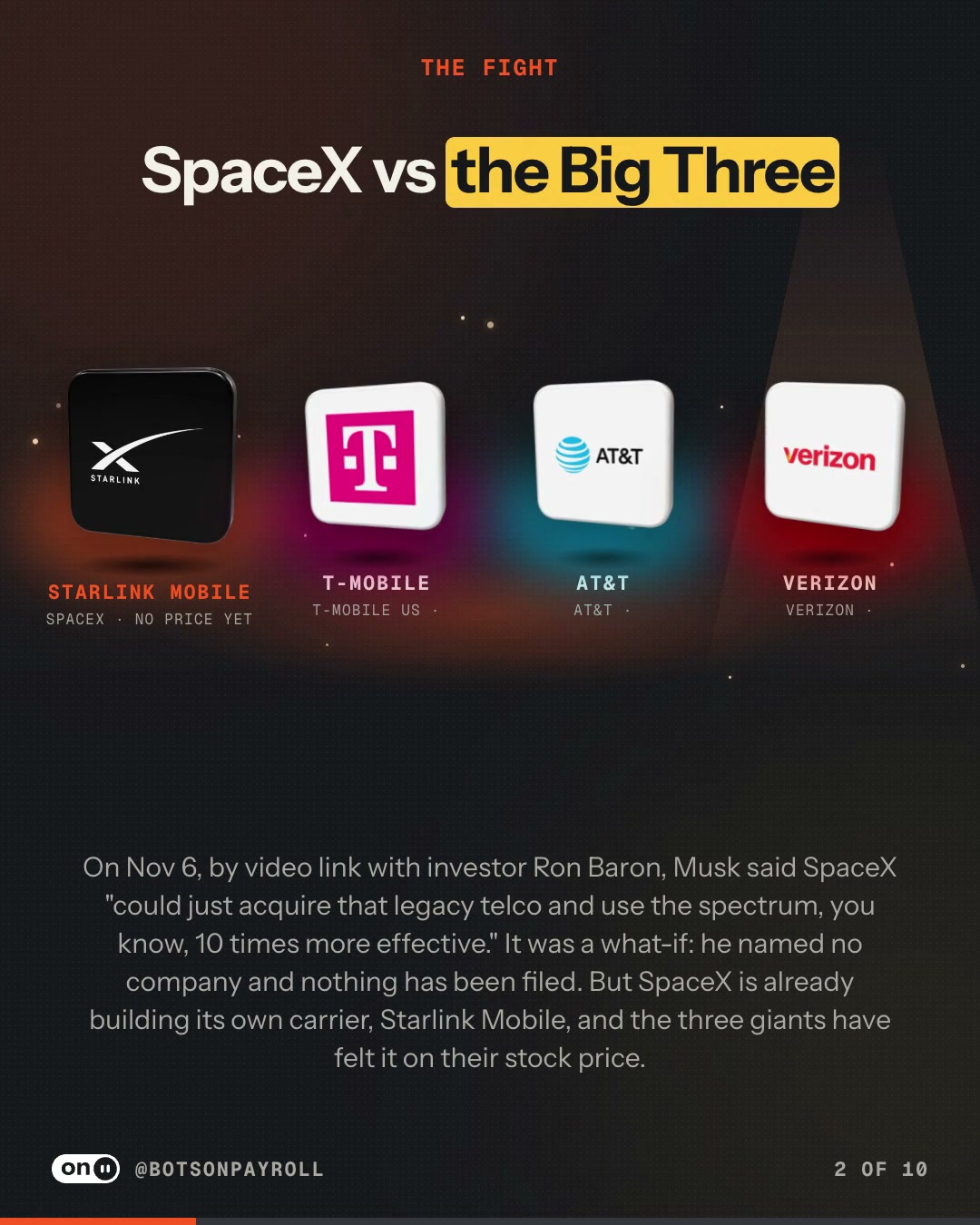
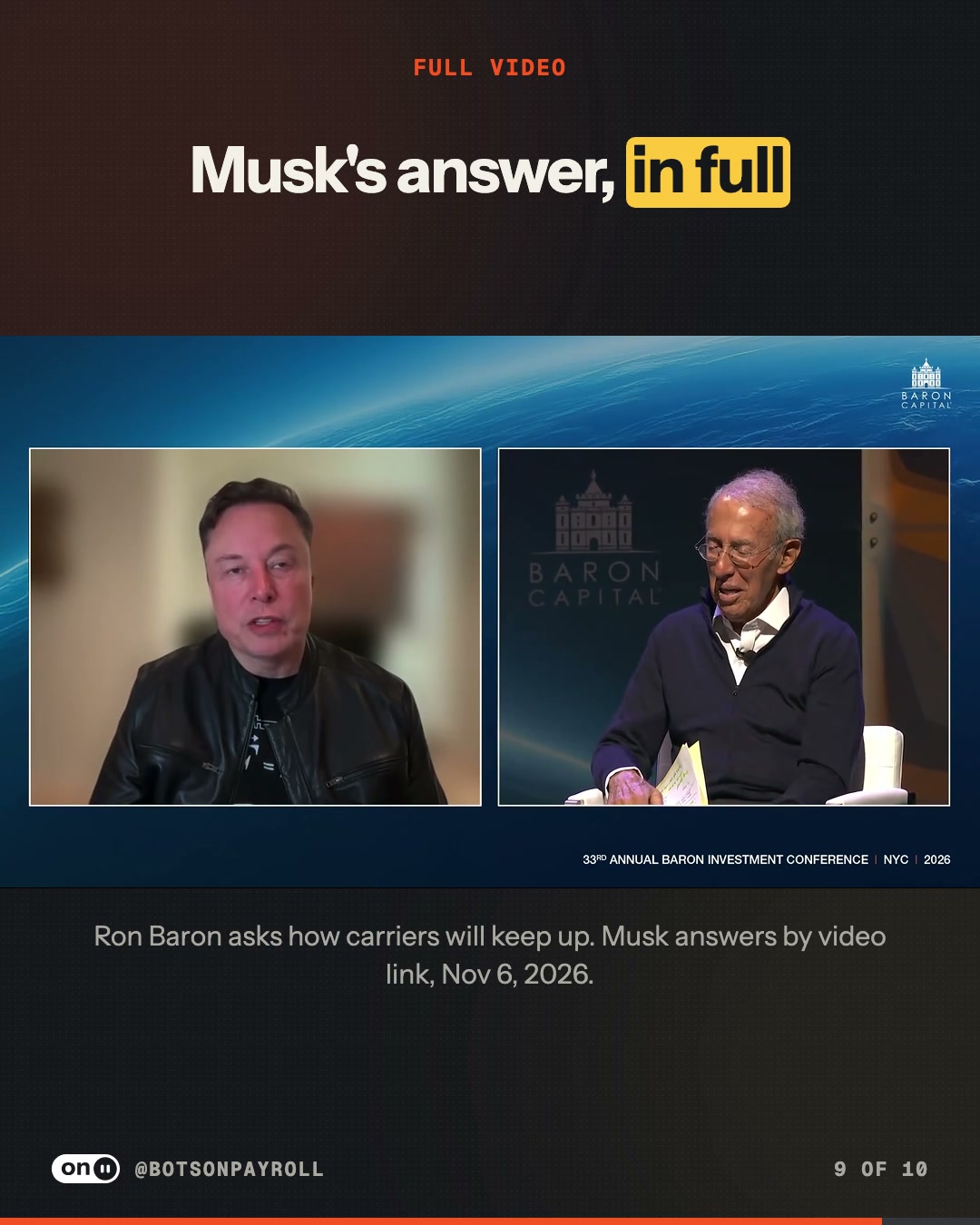
On Nov 6, by video link with investor Ron Baron, Musk said SpaceX "could just acquire that legacy telco and use the spectrum, you know, 10 times more effective." It was a what-if: he named no company and nothing has been filed. But SpaceX is already building its own carrier, Starlink Mobile, and the three giants have felt it on their stock price.
Who owns the airwaves
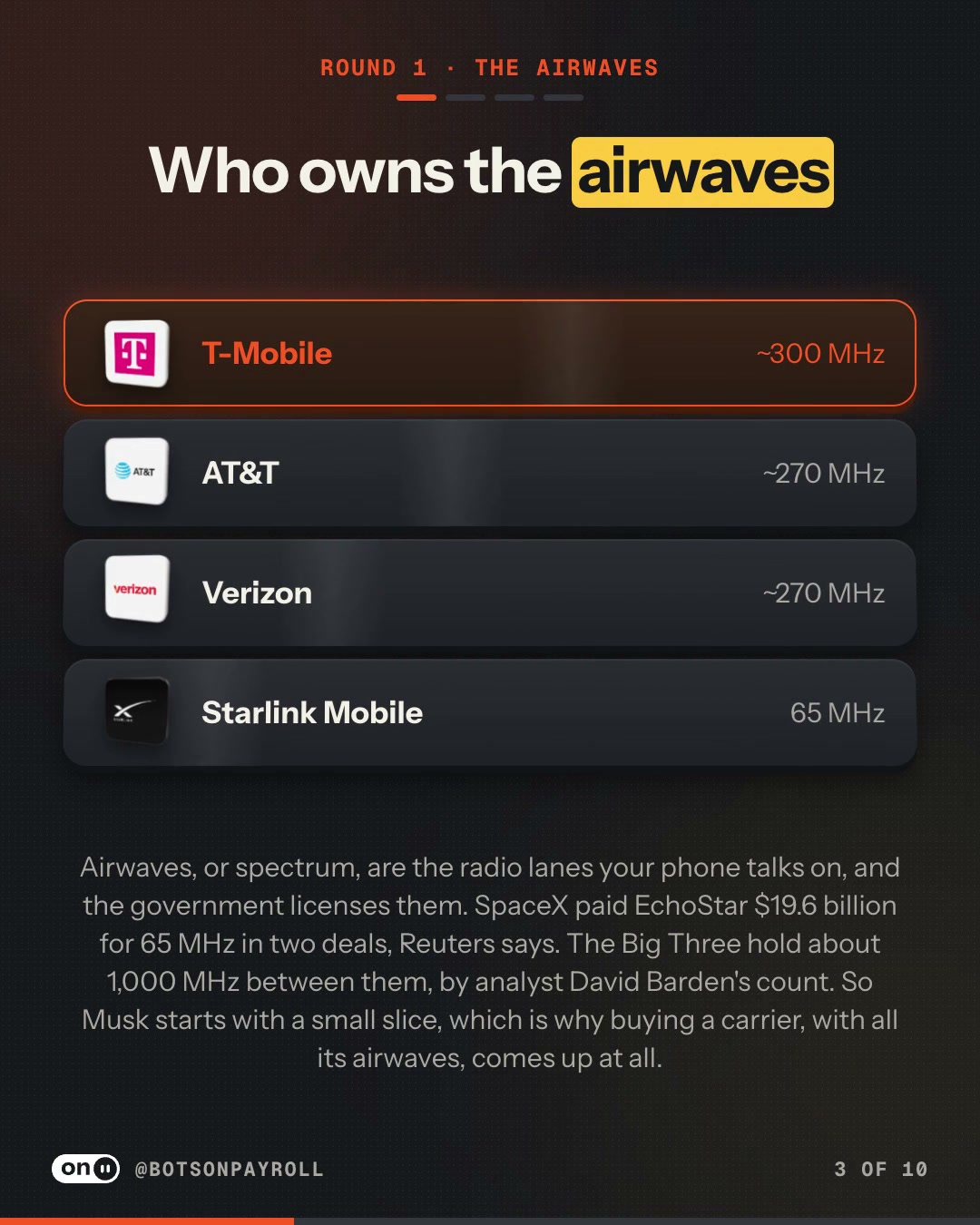
Airwaves, or spectrum, are the radio lanes your phone talks on, and the government licenses them. SpaceX paid EchoStar $19.6 billion for 65 MHz in two deals, Reuters says. The Big Three hold about 1,000 MHz between them, by analyst David Barden's count. So Musk starts with a small slice, which is why buying a carrier, with all its airwaves, comes up at all.
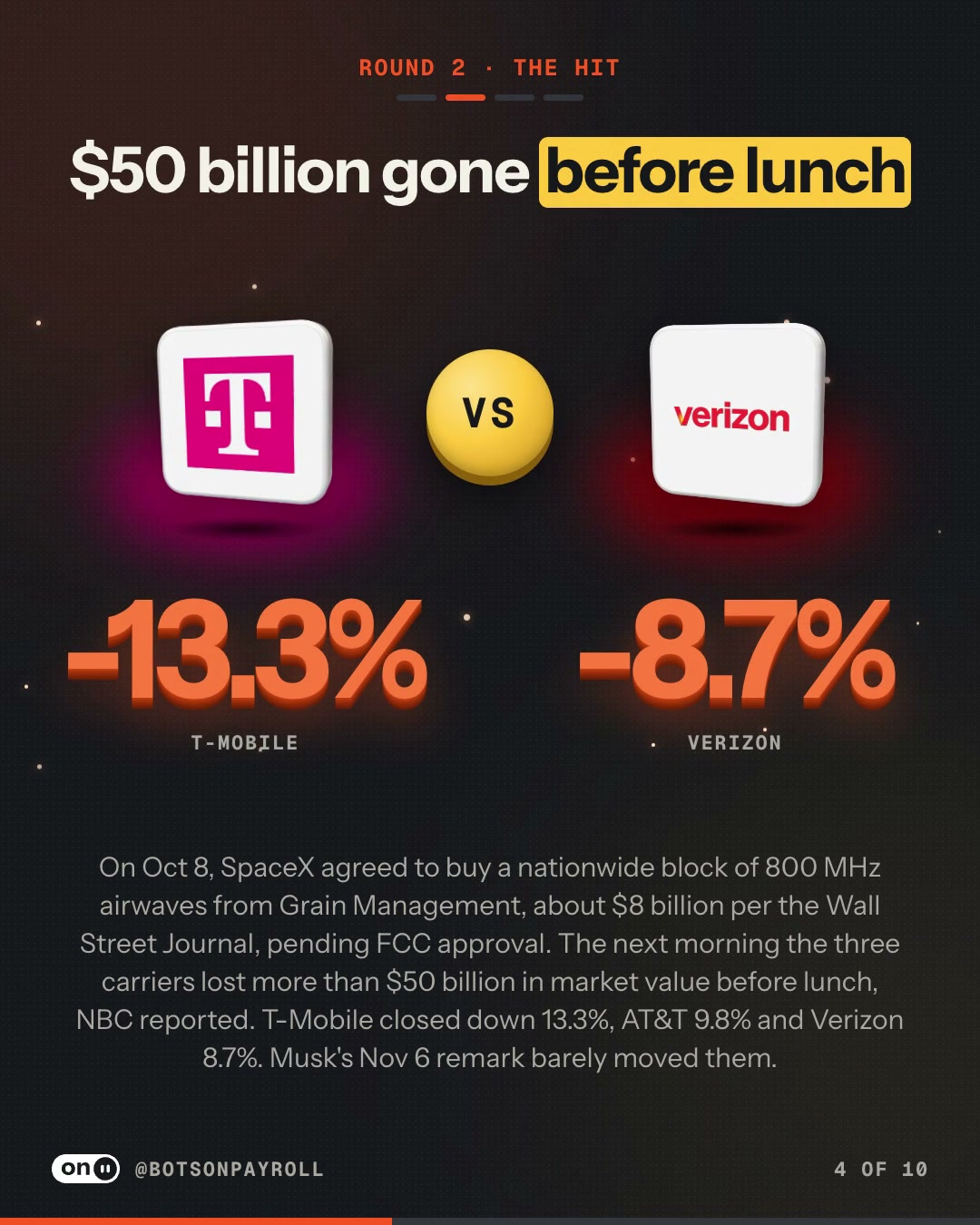
$50 billion gone before lunch
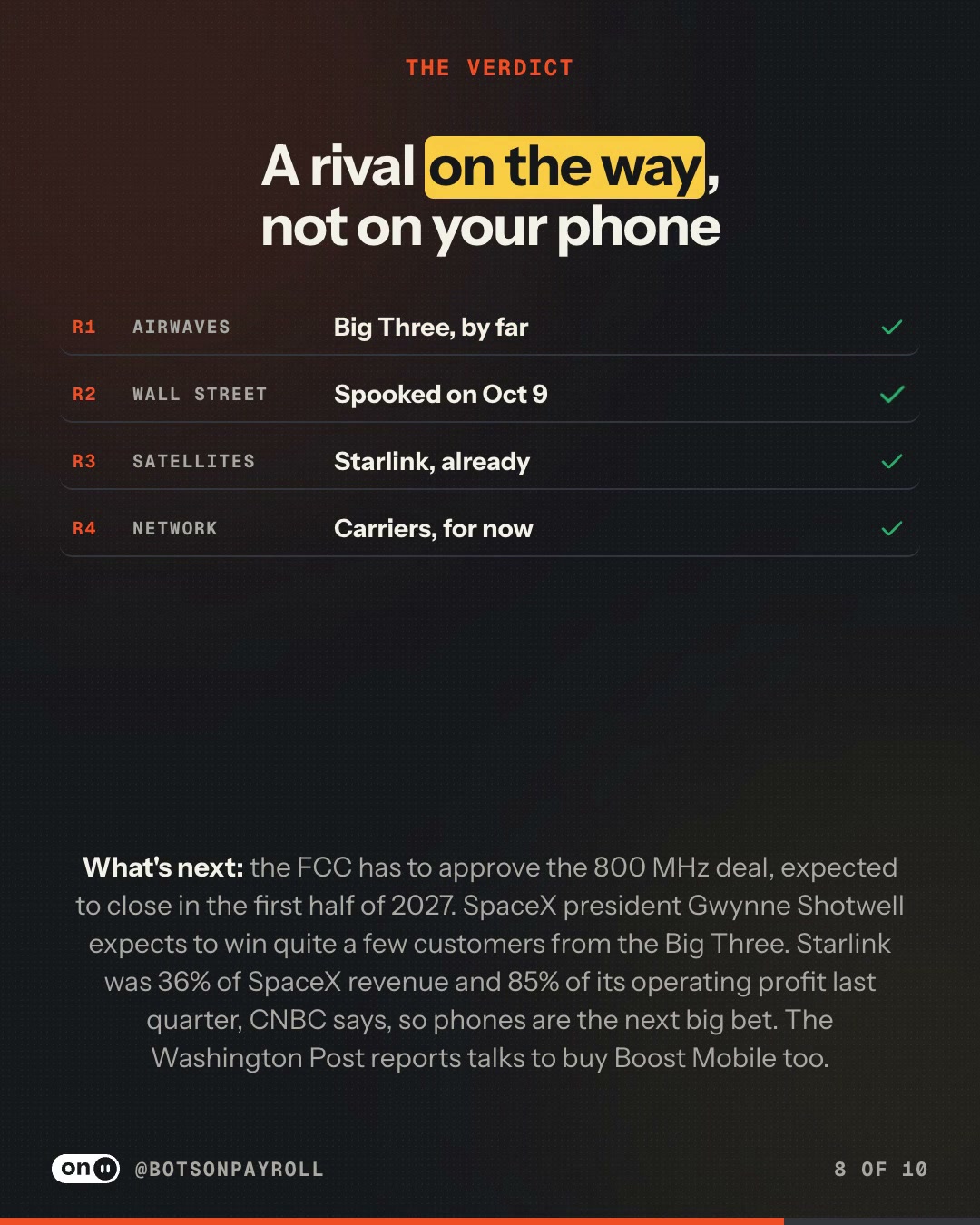
On Oct 8, SpaceX agreed to buy a nationwide block of 800 MHz airwaves from Grain Management, about $8 billion per the Wall Street Journal, pending FCC approval. The next morning the three carriers lost more than $50 billion in market value before lunch, NBC reported. T-Mobile closed down 13.3%, AT&T 9.8% and Verizon 8.7%. Musk's Nov 6 remark barely moved them.
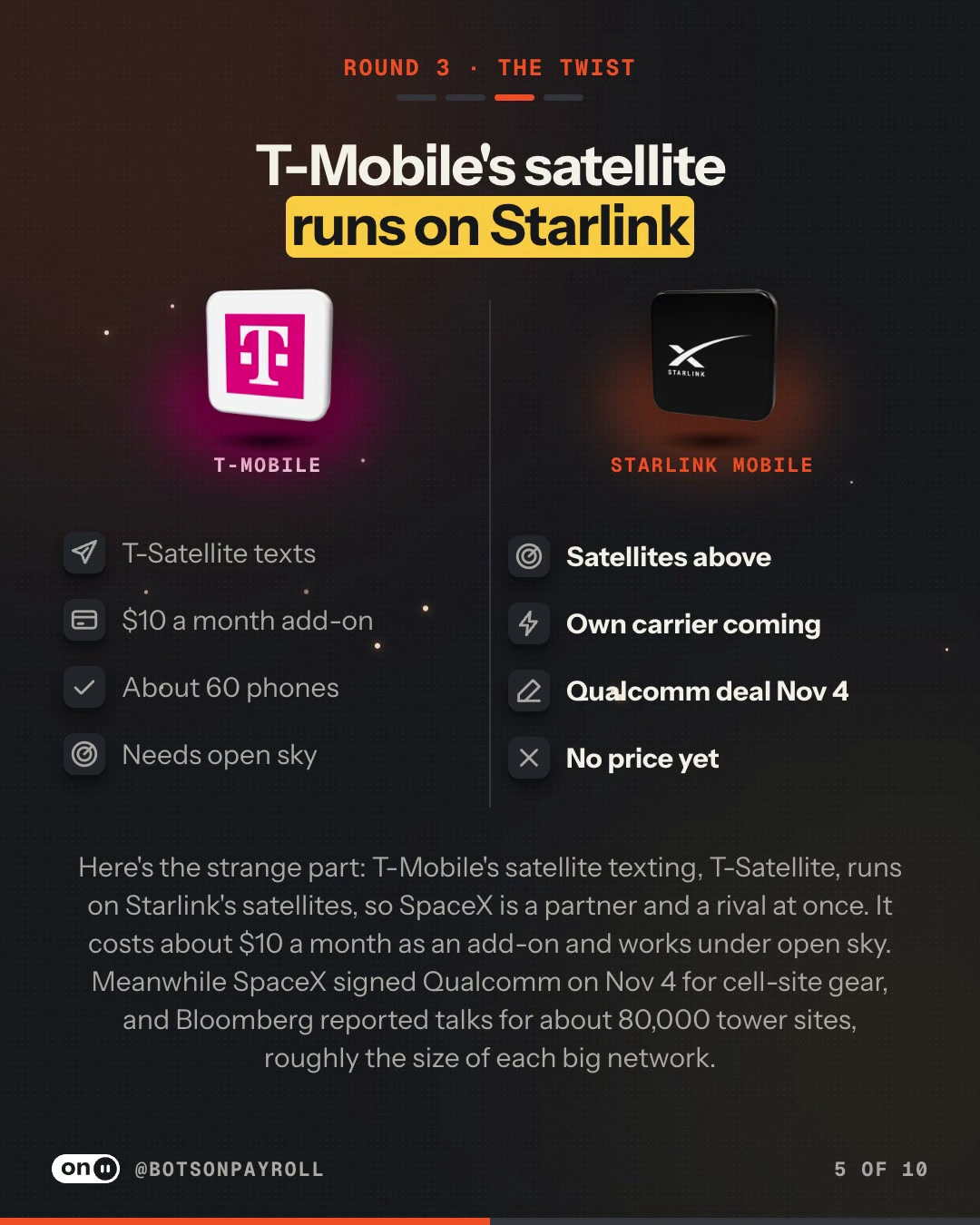
T-Mobile's satellite runs on Starlink
Here's the strange part: T-Mobile's satellite texting, T-Satellite, runs on Starlink's satellites, so SpaceX is a partner and a rival at once. It costs about $10 a month as an add-on and works under open sky. Meanwhile SpaceX signed Qualcomm on Nov 4 for cell-site gear, and Bloomberg reported talks for about 80,000 tower sites, roughly the size of each big network.
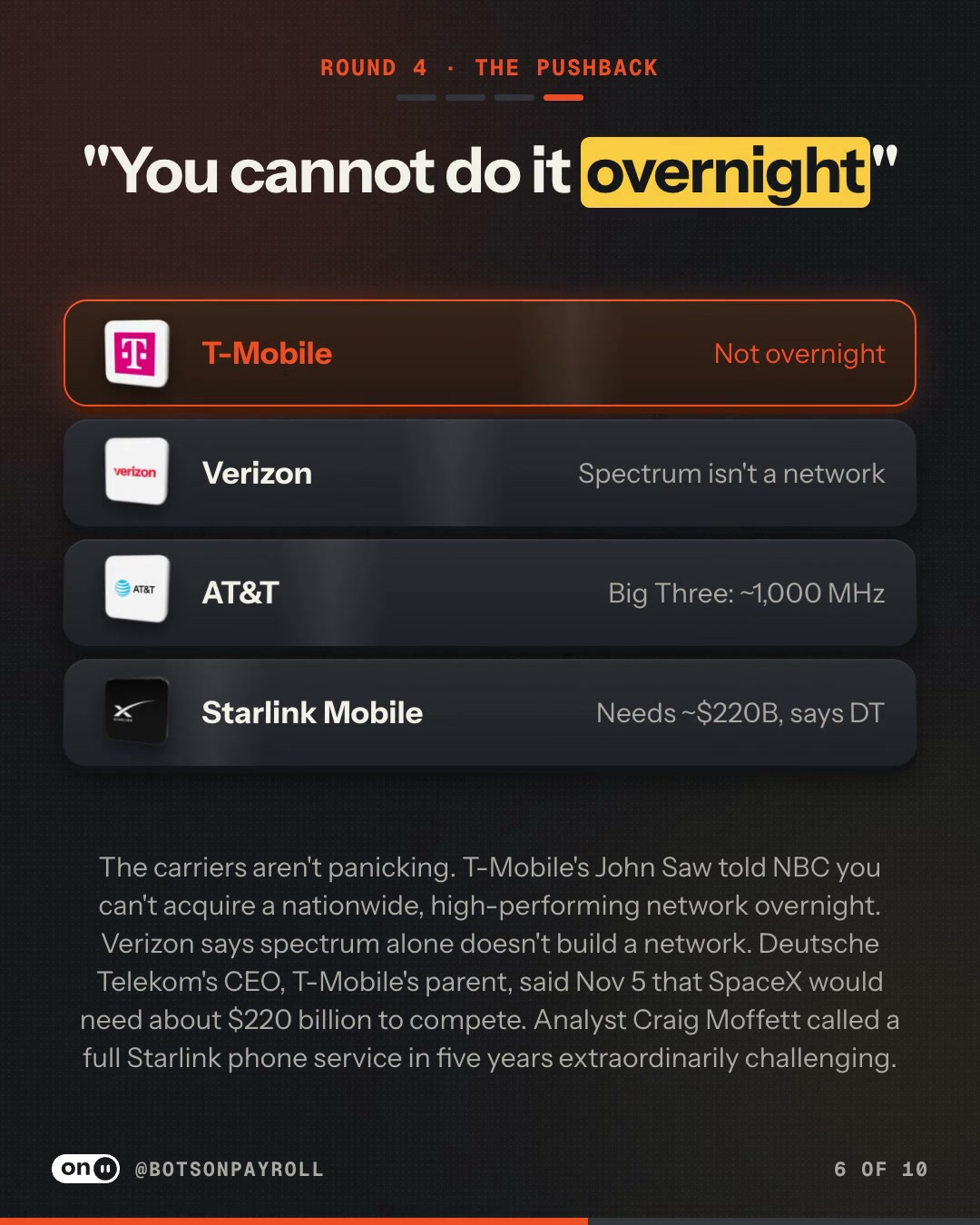
"You cannot do it overnight"
The carriers aren't panicking. T-Mobile's John Saw told NBC you can't acquire a nationwide, high-performing network overnight. Verizon says spectrum alone doesn't build a network. Deutsche Telekom's CEO, T-Mobile's parent, said Nov 5 that SpaceX would need about $220 billion to compete. Analyst Craig Moffett called a full Starlink phone service in five years extraordinarily challenging.
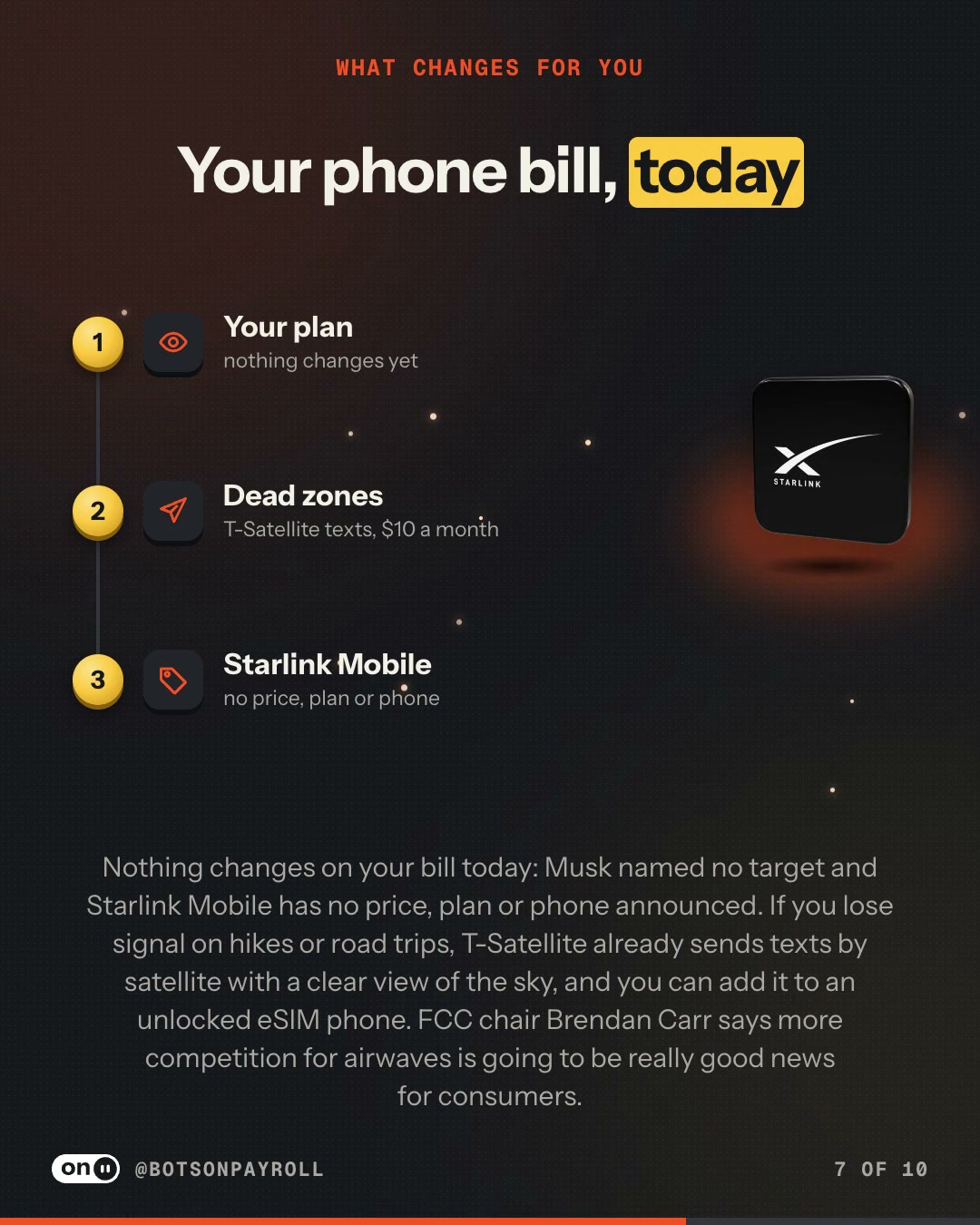
Your phone bill, today
Nothing changes on your bill today: Musk named no target and Starlink Mobile has no price, plan or phone announced. If you lose signal on hikes or road trips, T-Satellite already sends texts by satellite with a clear view of the sky, and you can add it to an unlocked eSIM phone. FCC chair Brendan Carr says more competition for airwaves is going to be really good news for consumers.
A rival on the way, not on your phone
What's next: the FCC has to approve the 800 MHz deal, expected to close in the first half of 2027. SpaceX president Gwynne Shotwell expects to win quite a few customers from the Big Three. Starlink was 36% of SpaceX revenue and 85% of its operating profit last quarter, CNBC says, so phones are the next big bet. The Washington Post reports talks to buy Boost Mobile too.
Swipe the post

Sources
- Yahoo Finance / 24/7 Wall St
- 24/7 Wall St
- InvestmentNews
- CNBC
- RTTNews
- Yahoo Finance
- NBC News
- Billionaires.africa (Oct 9 2026)
- TechCrunch
- Reuters via The Star
- CNBC
- Light Reading
- liveinthefuture.org (cites Reuters, Barron's; secondary)
- liveinthefuture.org (secondary)
- satelliteinternet.com (secondary)
- Dow Jones via iTiger
More AI news

Spent your weekend on sale posts? One photo could have made all of them.
Your pay stub link still opens. Here's how to lock it.