Jensen just put a $399 robot duck on stage
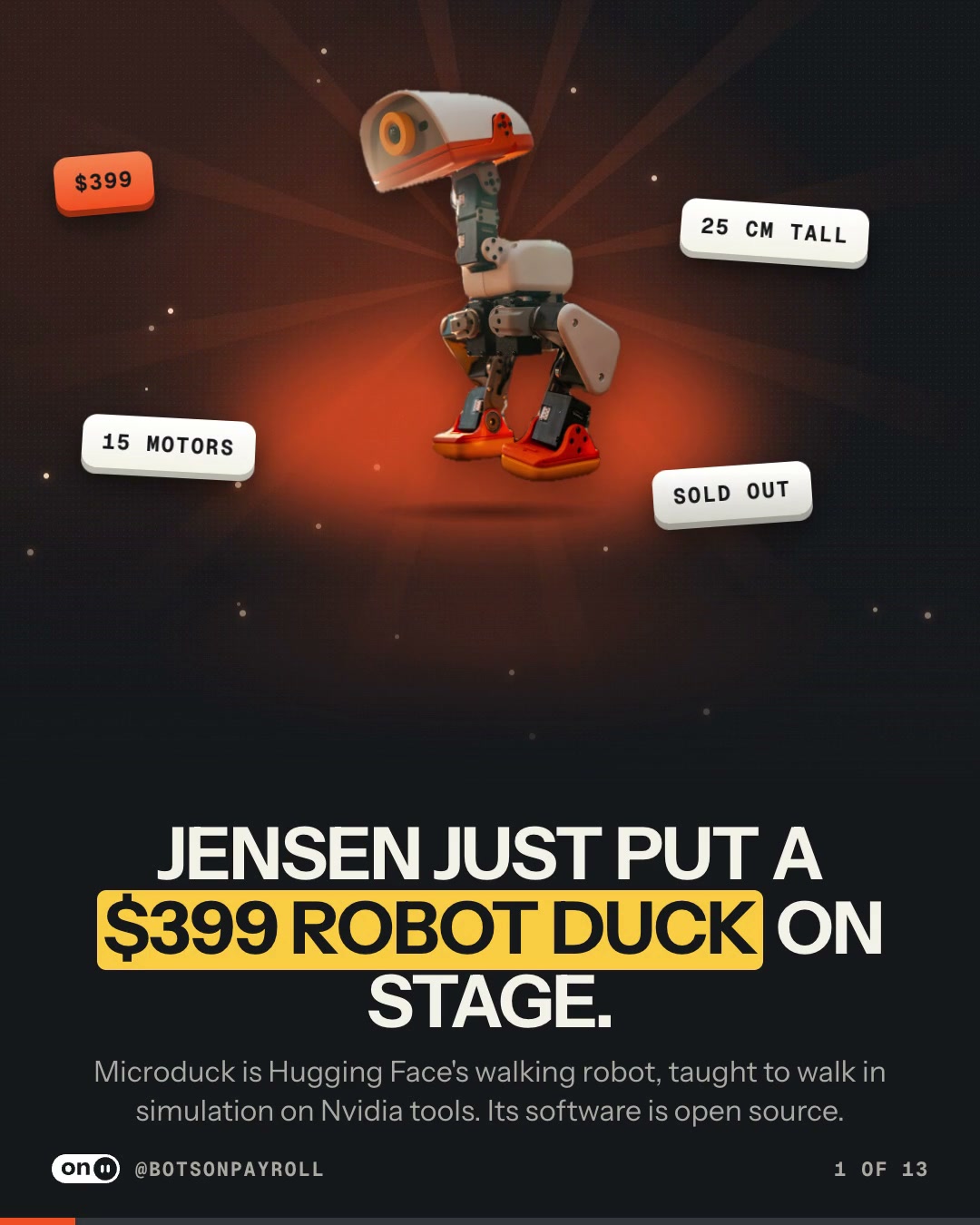
Jensen Huang closed Nvidia's GTC Berlin keynote with four Microducks, $399 walking robots from Pollen Robotics, the team inside Hugging Face. In Nvidia's demo, thousands of virtual ducks learned to walk in simulation.
By Bots on Payroll, with 17 sources below
The short version
- Microduck is Pollen Robotics' robot, not Nvidia's; Nvidia agreed to buy Hugging Face, closing in 2027.
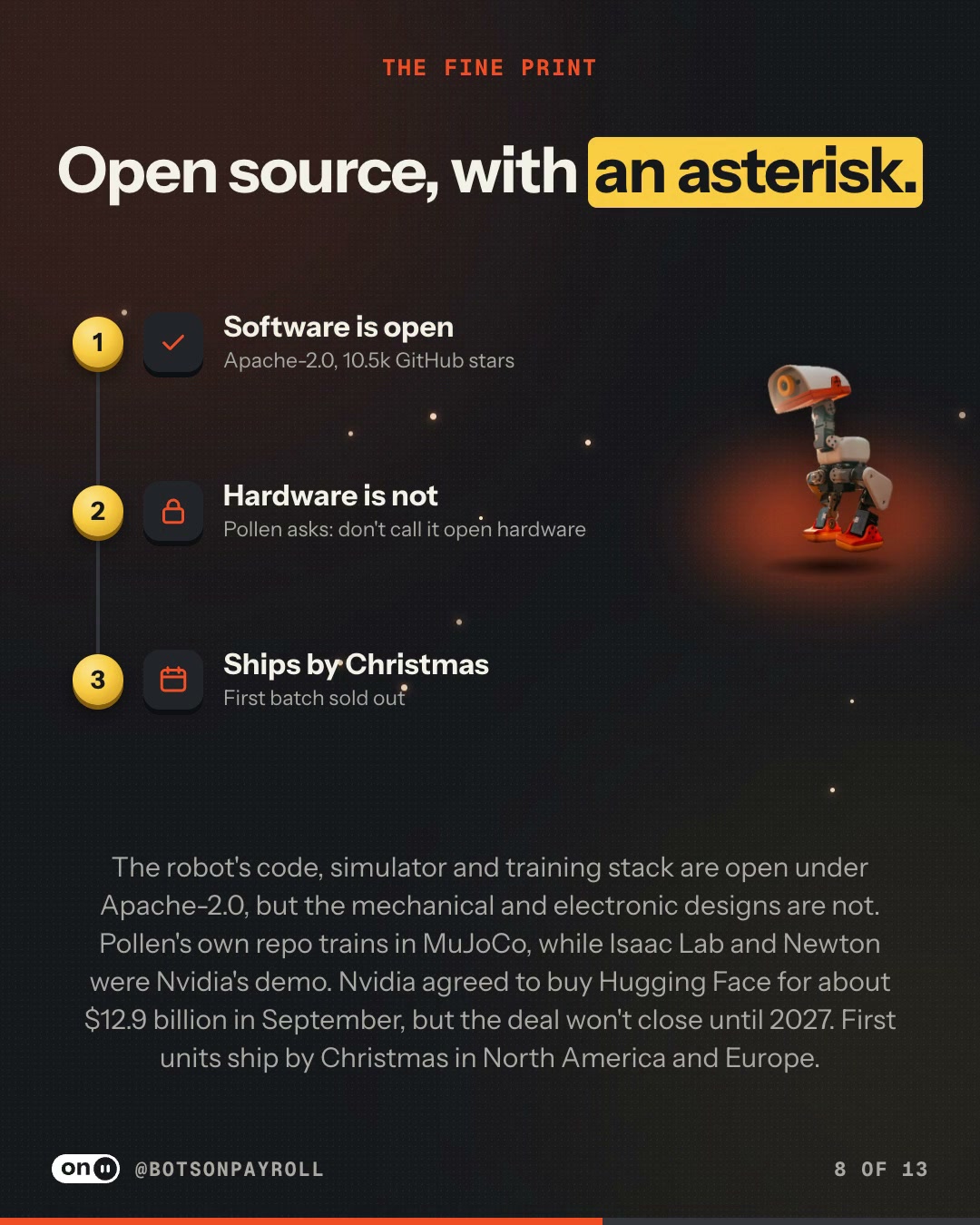
- Its software is open source under Apache-2.0; the hardware designs are not.
- The first $399 batch is sold out and ships by Christmas.
Watch the video
0:59, sound onFour ducks stole Nvidia's keynote
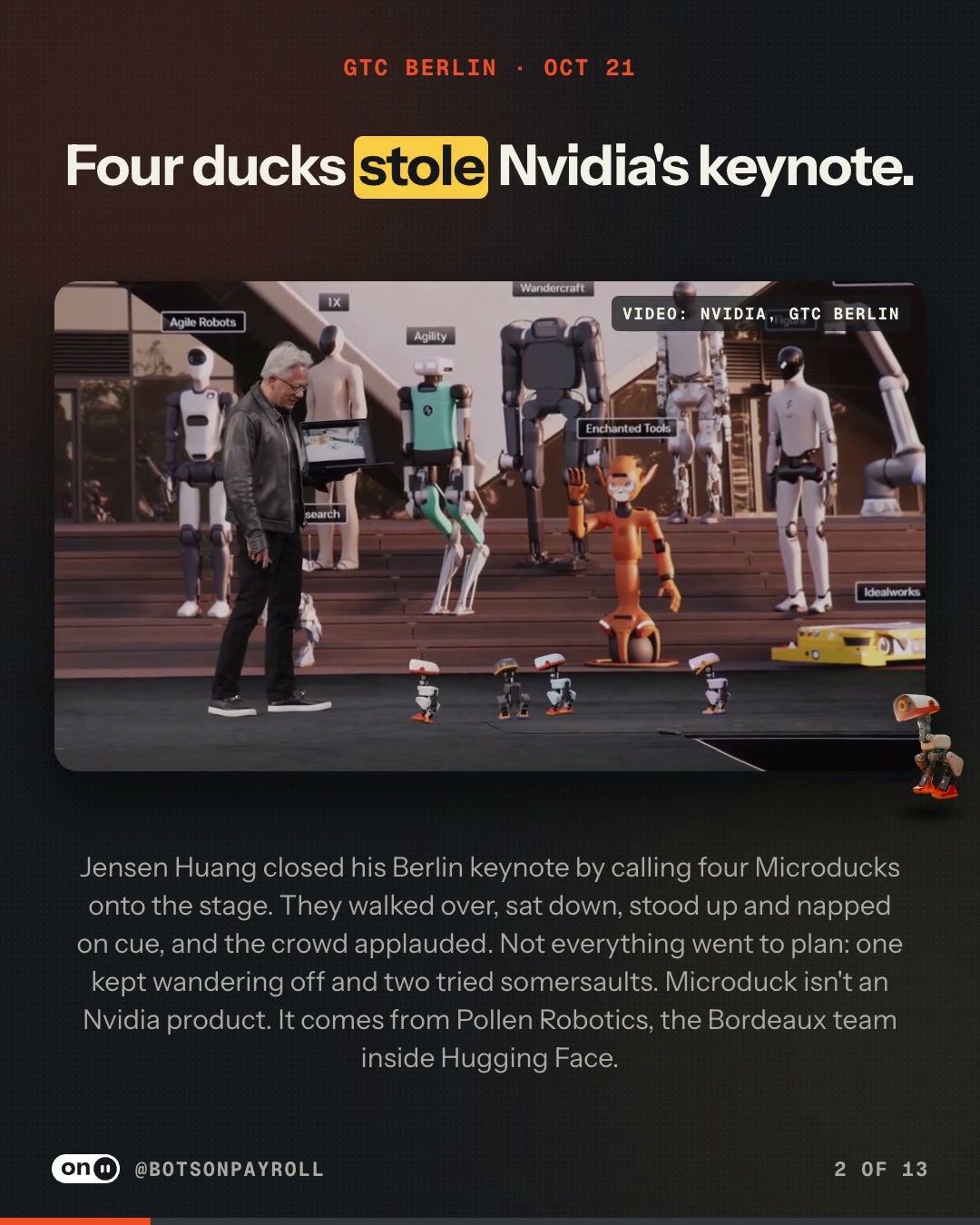
Jensen Huang closed his Berlin keynote by calling four Microducks onto the stage. They walked over, sat down, stood up and napped on cue, and the crowd applauded. Not everything went to plan: one kept wandering off and two tried somersaults. Microduck isn't an Nvidia product. It comes from Pollen Robotics, the Bordeaux team inside Hugging Face.
An AI agent taught it to walk
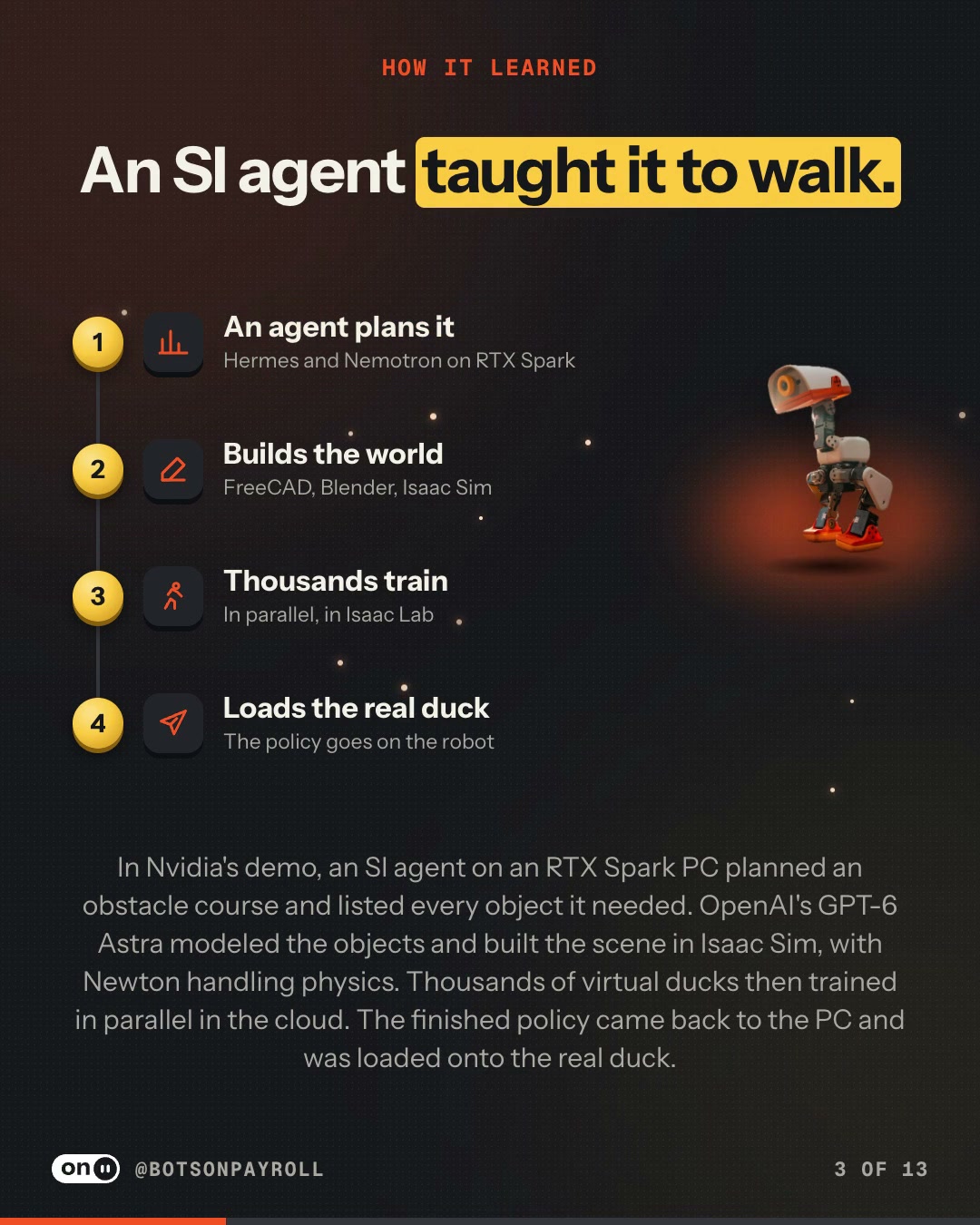
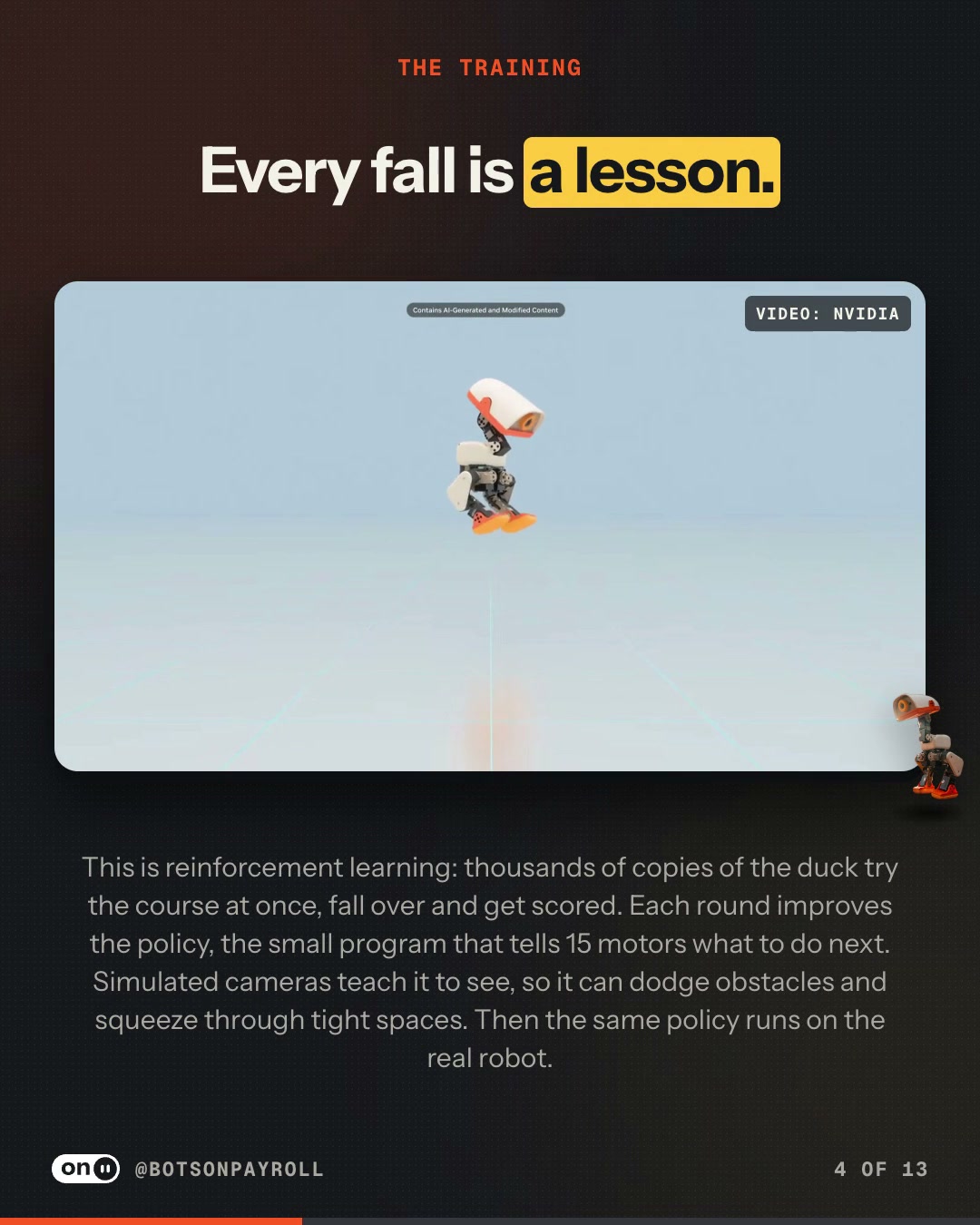
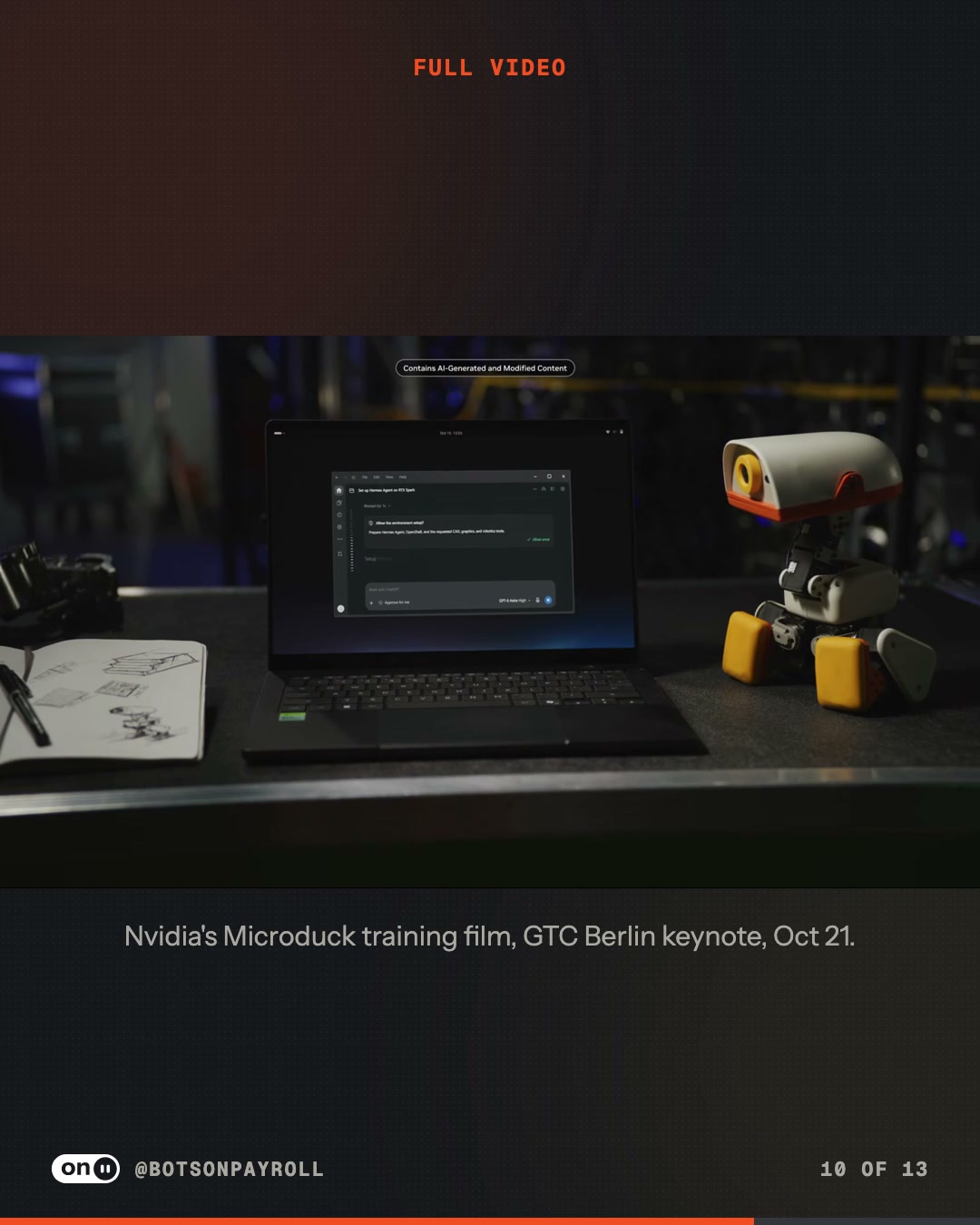
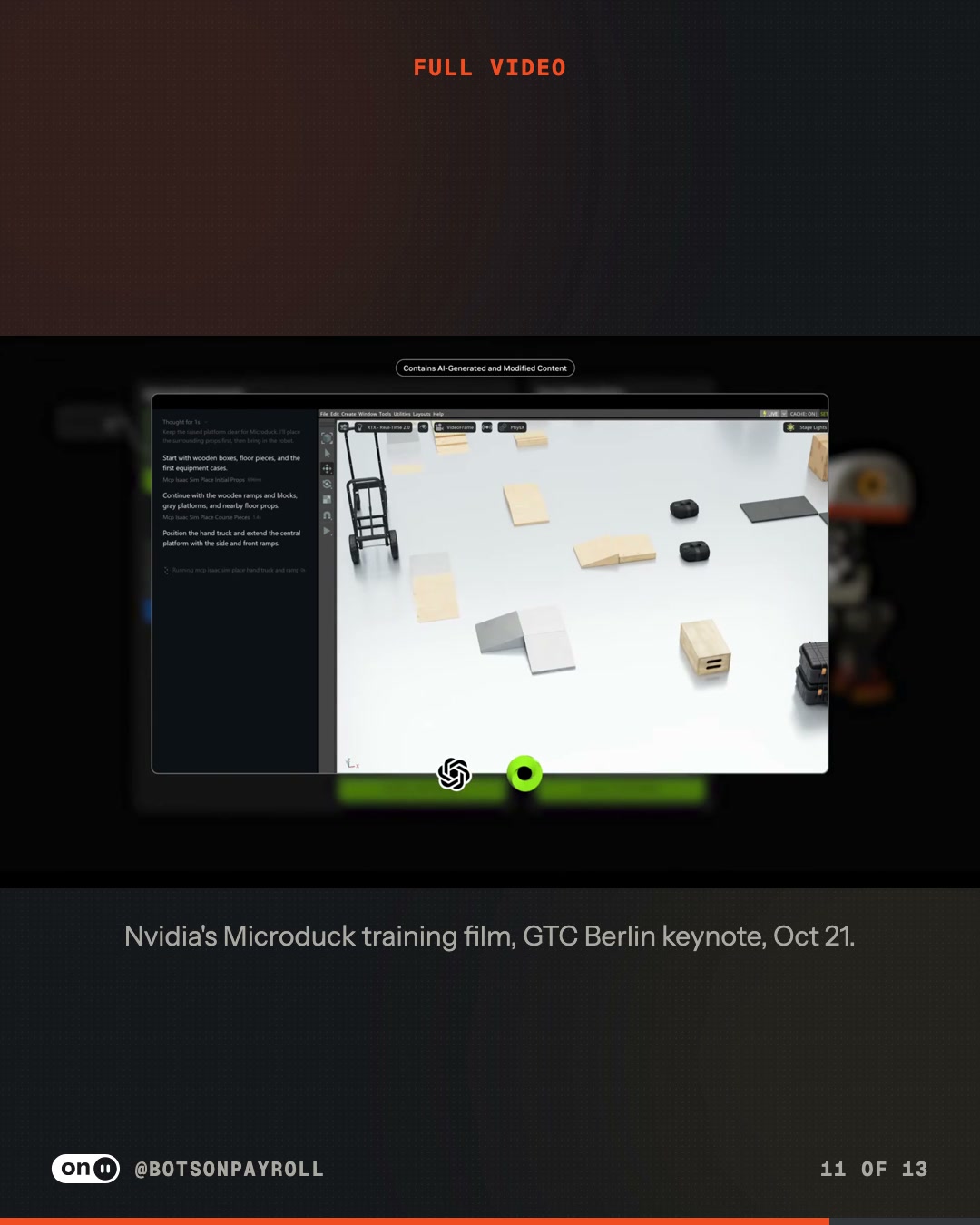
In Nvidia's demo, an AI agent on an RTX Spark PC planned an obstacle course and listed every object it needed. OpenAI's GPT-6 Astra modeled the objects and built the scene in Isaac Sim, with Newton handling physics. Thousands of virtual ducks then trained in parallel in the cloud. The finished policy came back to the PC and was loaded onto the real duck.
Every fall is a lesson
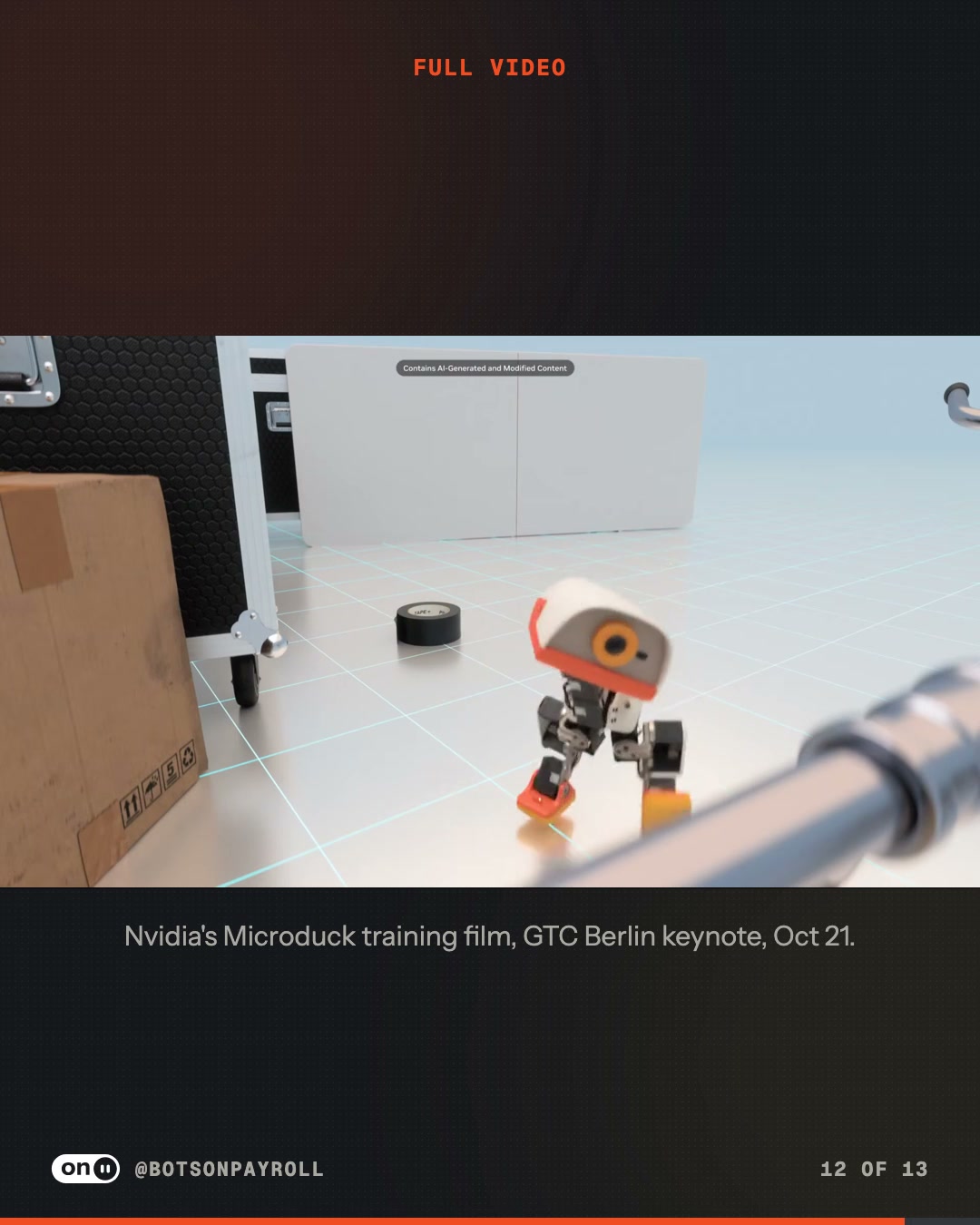
This is reinforcement learning: thousands of copies of the duck try the course at once, fall over and get scored. Each round improves the policy, the small program that tells 15 motors what to do next. Simulated cameras teach it to see, so it can dodge obstacles and squeeze through tight spaces. Then the same policy runs on the real robot.
What's inside the duck
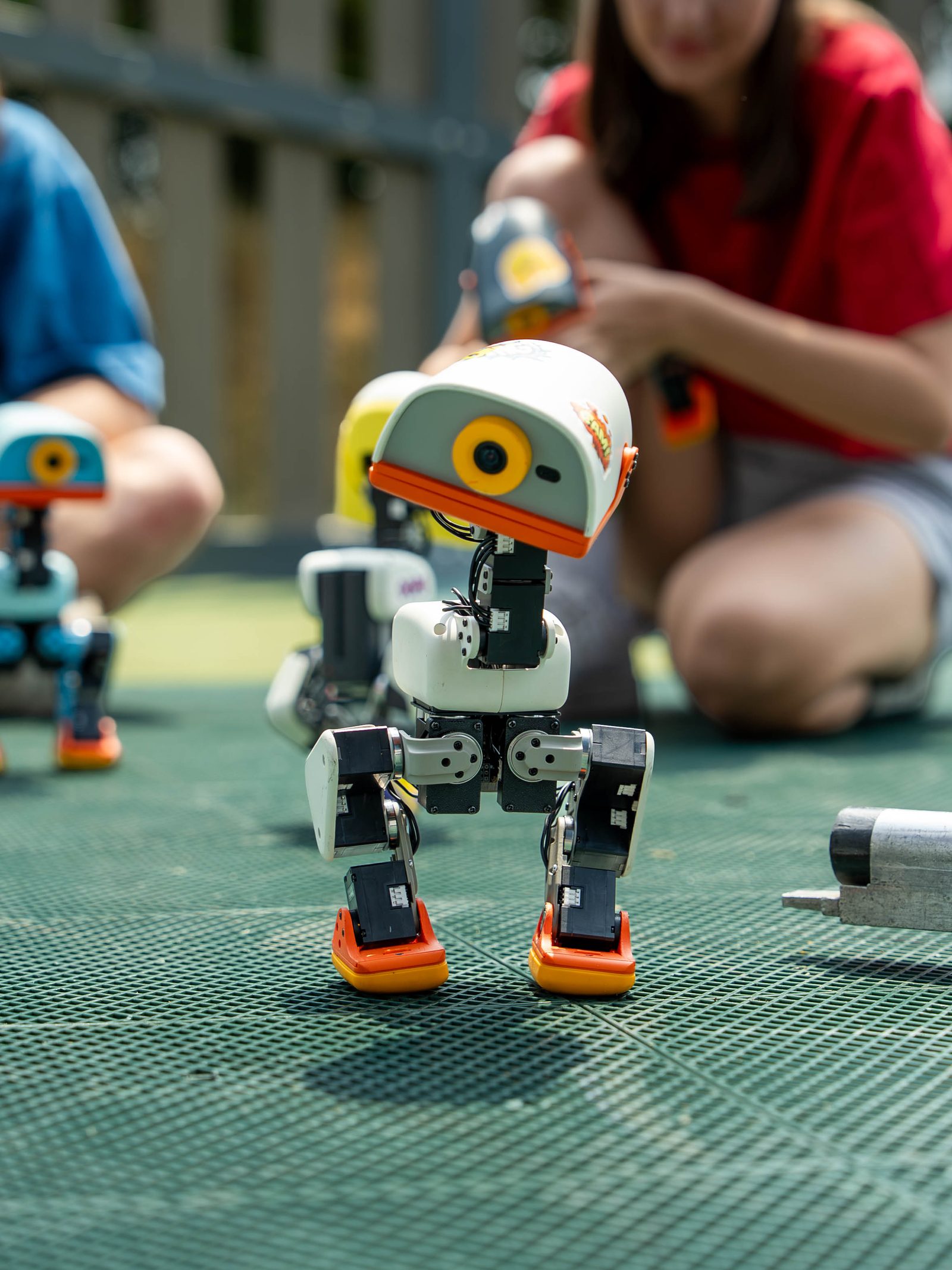
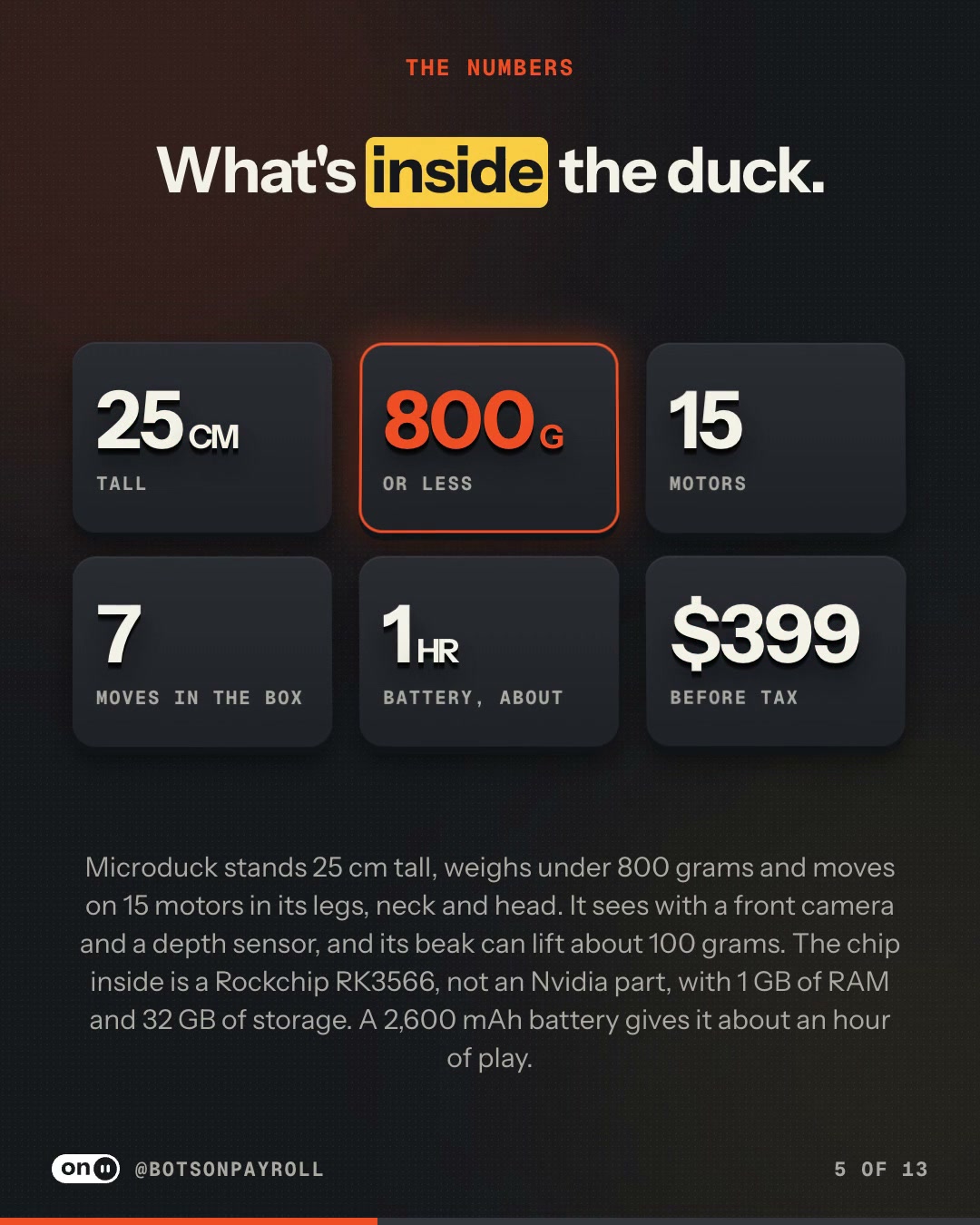
Microduck stands 25 cm tall, weighs under 800 grams and moves on 15 motors in its legs, neck and head. It sees with a front camera and a depth sensor, and its beak can lift about 100 grams. The chip inside is a Rockchip RK3566, not an Nvidia part, with 1 GB of RAM and 32 GB of storage. A 2,600 mAh battery gives it about an hour of play.
It gets back up on its own
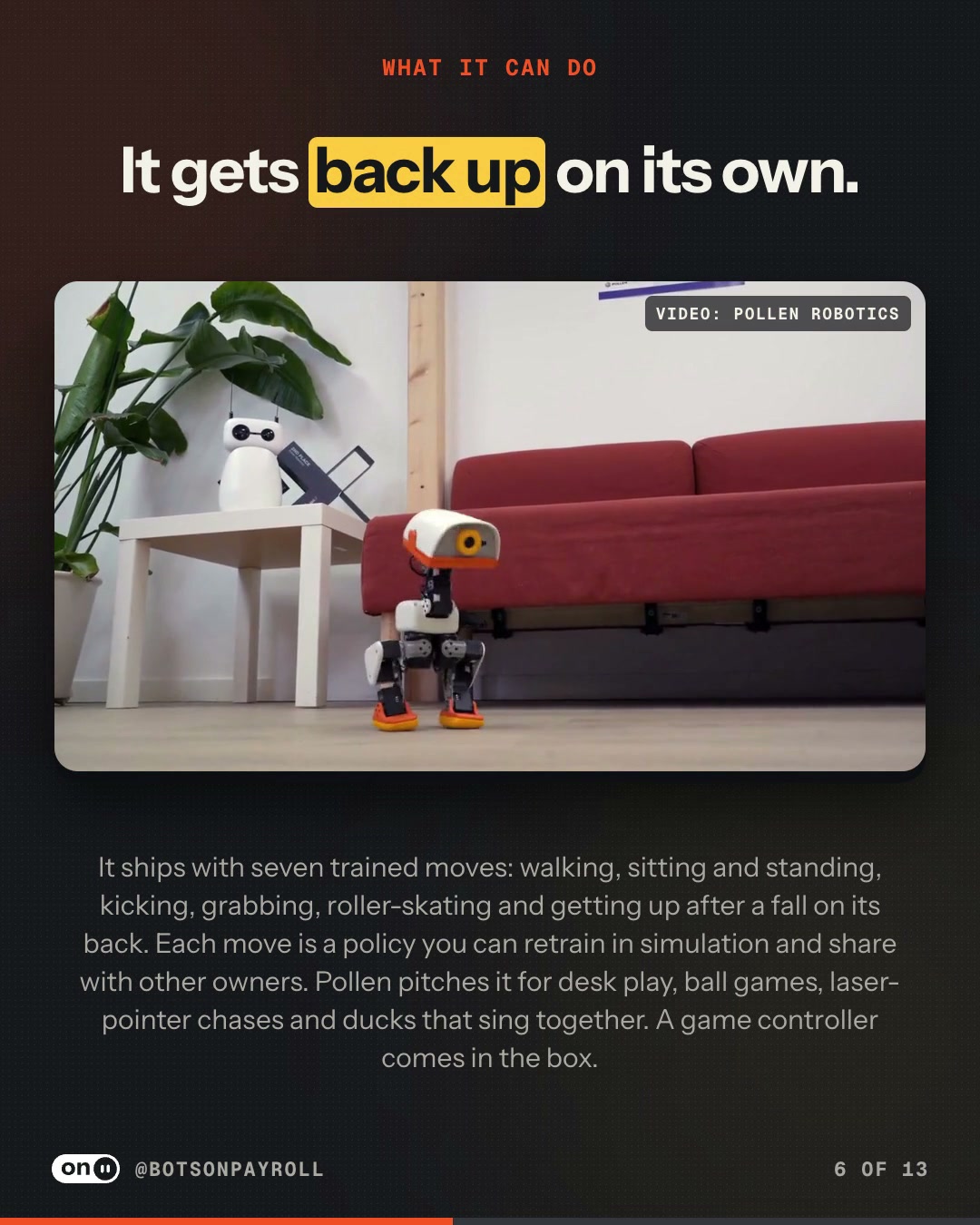
It ships with seven trained moves: walking, sitting and standing, kicking, grabbing, roller-skating and getting up after a fall on its back. Each move is a policy you can retrain in simulation and share with other owners. Pollen pitches it for desk play, ball games, laser-pointer chases and ducks that sing together. A game controller comes in the box.
A walking robot for the price of a phone
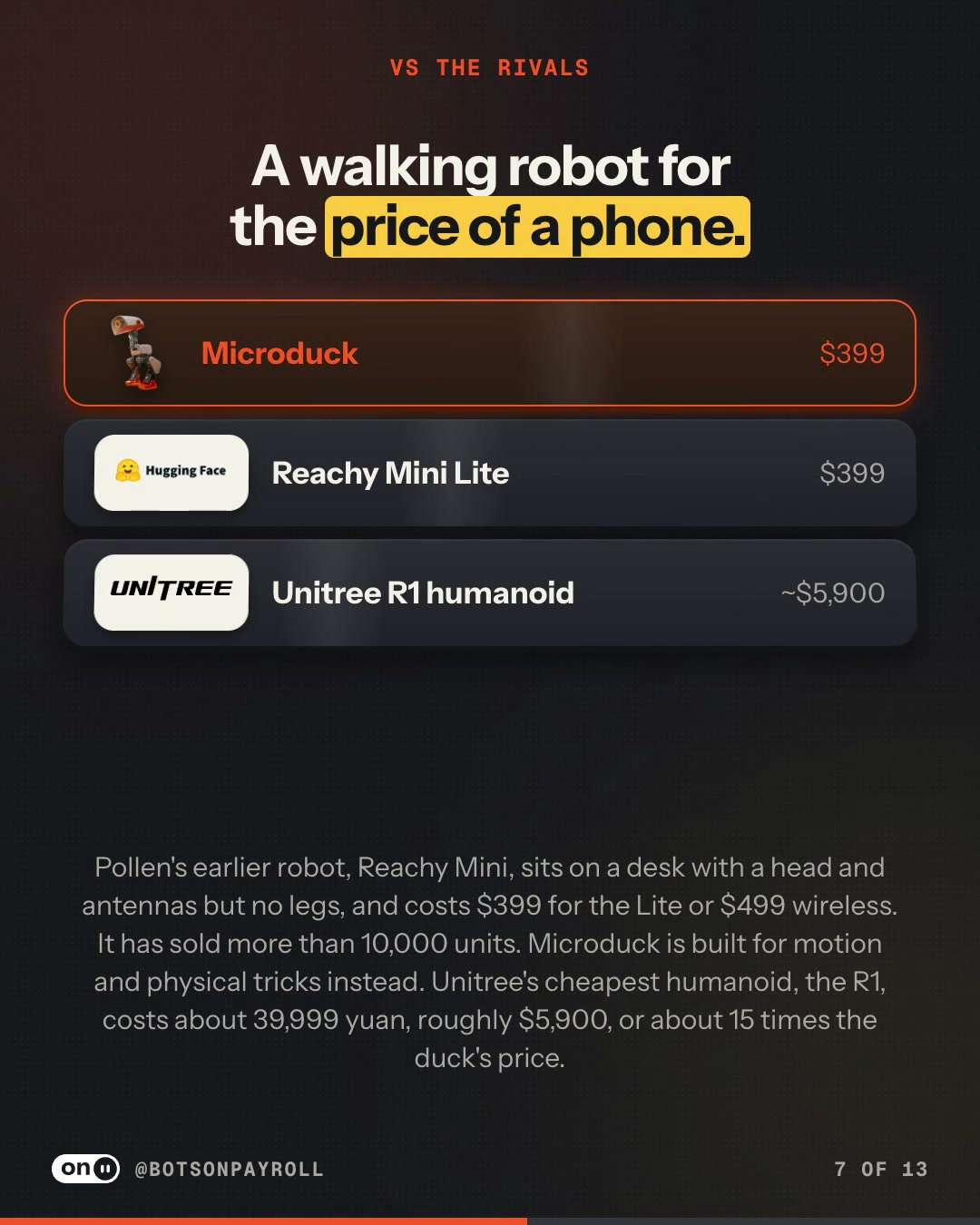
Pollen's earlier robot, Reachy Mini, sits on a desk with a head and antennas but no legs, and costs $399 for the Lite or $499 wireless. It has sold more than 10,000 units. Microduck is built for motion and physical tricks instead. Unitree's cheapest humanoid, the R1, costs about 39,999 yuan, roughly $5,900, or about 15 times the duck's price.
Open source, with an asterisk
The robot's code, simulator and training stack are open under Apache-2.0, but the mechanical and electronic designs are not. Pollen's own repo trains in MuJoCo, while Isaac Lab and Newton were Nvidia's demo. Nvidia agreed to buy Hugging Face for about $12.9 billion in September, but the deal won't close until 2027. First units ship by Christmas in North America and Europe.
Jensen told 20 million viewers to buy one
On stage, Huang told the ducks everybody loves them so much they're sold out, then told viewers to order from Pollen's website. The $399 preorder window opened Aug 27 and the first batch is gone. Bloomberg quoted Hugging Face co-founder Thomas Wolf saying one sold every four seconds at launch. Hugging Face says it aims to sell over 20,000.
From the source
- PRICE
- $399 before tax.
- SIZE
- 25 cm, under 800 g.
- MOTORS
- 15.
- MAKER
- Pollen Robotics (Hugging Face).
Swipe the post


Sources
More AI news

Spent your weekend on sale posts? One photo could have made all of them.
Your pay stub link still opens. Here's how to lock it.